
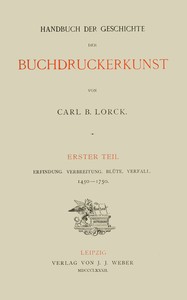
Handbuch der Geschichte der Buchdruckerkunst. Erster Teil by Carl Berendt Lorck
So, what's this book actually about? Let's be clear: this isn't a novel. Handbuch der Geschichte der Buchdruckerkunst (which translates to 'Handbook of the History of the Art of Printing') is the first part of a massive, detailed history written in the 19th century. But don't let that scare you off. Lorck doesn't just list dates and names. He builds the world.
The Story
Lorck starts at the very beginning, before Gutenberg. He paints a picture of a Europe where every book was copied by hand, making them rare and expensive treasures. Then, he introduces the puzzle of printing's invention—it wasn't one 'Eureka!' moment but a series of experiments and rival claims. The real story, as Lorck tells it, is what happened next. He follows the printers themselves, these adventurous craftsmen who traveled from city to city with their heavy type and presses. He shows how they formed guilds, fought over patents, and often operated in a legal gray area. The book tracks how printed pamphlets fueled the Reformation, how kings tried to censor presses, and how this new power to copy words cheaply and quickly began to reshape politics, religion, and science forever.
Why You Should Read It
I loved this because it made me see something familiar in a completely new light. We take books and news for granted. Lorck reminds us that there was a time when mass communication was a radical, disruptive, and dangerous technology. Reading his account feels like watching the birth of the internet—but in the 15th century. You get the excitement, the fear, the genius, and the scoundrels. He has strong opinions about which historical claims are true, which adds a personal, almost argumentative flavor to the writing. It's a history book with a point of view.
Final Verdict
This is a specialized book, no doubt. It's perfect for history buffs, book lovers, or anyone fascinated by how technology changes society. It's not a quick, casual read; it's a deep, engaging study. Think of it as a masterclass in the most important communications revolution before the digital age. If you're willing to put in the time, Lorck rewards you with a rich, compelling narrative that explains not just how we got the printed book, but how the printed book got us.
Jennifer Hill
7 months agoGood quality content.
Sandra Wright
2 months agoComprehensive and well-researched.




Noah Flores
1 month agoRecommended.