
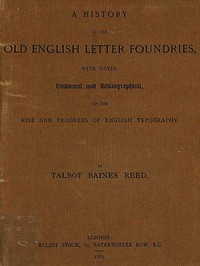
A History of the Old English Letter Foundries by Talbot Baines Reed
Let's be clear: this is a book about metal letters. But stick with me, because it turns out that story is a gripping saga of national pride, artistic rivalry, and cutthroat business.
The Story
A History of the Old English Letter Foundries isn't a novel with a plot, but its narrative is driven by a simple, powerful question: how did England get its own typographic voice? For a long time after the printing press arrived, England imported its type or copied foreign designs. Reed walks us through the 18th and 19th centuries, introducing us to the pioneers who changed that. We meet people like William Caslon, whose clear, sturdy typeface became a standard, and John Baskerville, a perfectionist whose beautiful fonts were initially hated for being too radical. The book follows their technical triumphs, their bitter feuds, and the constant legal fights over who owned the designs for these tiny pieces of metal. It's the story of craftsmanship clashing with commerce, all to build the visual foundation of English books and, eventually, public life.
Why You Should Read It
I picked this up expecting a reference book and found a human drama. Reed, writing in the 1880s, had a passion for the subject that’s contagious. He doesn't just list facts; he shows you why these arguments over type mattered. You realize that the shape of our letters wasn't an accident—it was fought for. Reading it made me look at every book, sign, and website differently. You start to see the personality in the type. That bold headline? That friendly script? Each is the descendant of decisions made by these founders. It gives a wonderful, tangible history to something we usually take for granted.
Final Verdict
This isn't a casual beach read. It's a rich, detailed history. But if you have even a passing interest in design, history, publishing, or the stories behind everyday things, it's absolutely fascinating. It's perfect for history buffs who like niche deep-dives, graphic designers wanting to know their roots, and any curious reader who enjoys learning how the world got put together, one piece at a time—in this case, one letter at a time.
George Flores
1 year agoWithout a doubt, it creates a vivid world that you simply do not want to leave. A true masterpiece.
Anthony Hill
11 months agoI have to admit, the pacing is just right, keeping you engaged. I will read more from this author.
Donna Hill
1 year agoI came across this while browsing and the plot twists are genuinely surprising. This story will stay with me.




Joshua Williams
1 year agoThis is one of those stories where the atmosphere created is totally immersive. Don't hesitate to start reading.