
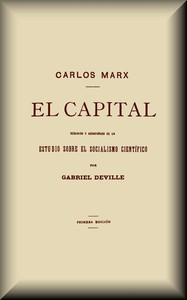
El capital: Resumido y acompañado de un estudio sobre el Socialismo científico
Let's be real: tackling Marx's Das Kapital is a project. It's long, detailed, and written in a 19th-century academic style. Gabriel Deville's book is essentially a two-for-one deal aimed at making that project achievable. First, he provides a condensed summary of Marx's monumental work, breaking down its core arguments about capitalism, labor, and value. Then, he doesn't just leave you there. He adds his own substantial essay on 'scientific socialism,' which acts like a bridge, connecting Marx's economic theories to the broader political and philosophical movement they inspired.
The Story
There isn't a narrative with characters in the traditional sense. The 'plot' is the unfolding of an idea. Deville walks you through the central mechanics Marx described: how capitalism generates profit, why Marx argued workers are exploited, and what contradictions he saw built into the system. The 'sequel' to this summary is Deville's study, which argues that socialism isn't just a wish or a moral stance, but a logical, scientific outcome of these economic forces. He presents it as the next, inevitable stage of social development.
Why You Should Read It
This book is a time capsule and a key. Reading it today, you get a direct look at how a passionate socialist intellectual at the turn of the 20th century interpreted and championed Marx's work. It's not a dry, neutral textbook. Deville has a point of view, and that's what makes it engaging. You're not just getting facts; you're seeing how those facts were weaponized into a worldview. It helps you understand the intellectual fuel that powered revolutions and political movements for decades to come. Even if you ultimately disagree with the conclusions, understanding this perspective is crucial for making sense of modern history, politics, and economics.
Final Verdict
This is the perfect book for the intellectually curious non-specialist. If you're a history buff, a political science student, or just someone who wants to move beyond soundbites and truly grasp one of the most influential ideologies of the modern era, start here. It's also great for book clubs looking to tackle a challenging topic—Deville's summary gives everyone a common foundation to debate from. It's not an easy beach read, but it's a remarkably efficient and clear portal into a massively important set of ideas.
Steven Young
1 year agoHigh quality edition, very readable.
Richard Martin
11 months agoTo be perfectly clear, the content flows smoothly from one chapter to the next. Thanks for sharing this review.
Dorothy Wilson
1 year agoA bit long but worth it.
Joseph Miller
1 month agoGreat reference material for my coursework.








Jennifer Clark
1 year agoGreat read!