
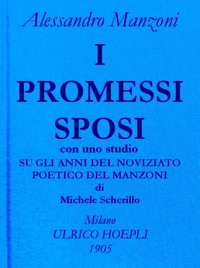
I promessi sposi. by Alessandro Manzoni
Imagine you're planning a simple, happy wedding. Then, on the eve of the ceremony, a local bully backed by a corrupt nobleman shows up and says you can't get married. That's where we meet Renzo and Lucia, two villagers in 17th-century Lombardy. Their desperate struggle to be together forces them to flee their home, sending them on separate, dangerous paths through an Italy ravaged by war, famine, and the bubonic plague.
The Story
The book follows Renzo and Lucia as they are torn apart. Lucia is hidden away in a convent, then kidnapped. Renzo, angry and confused, gets tangled up in a bread riot in Milan and has to flee the city. Their story is constantly interrupted by the huge events of their time—the Spanish occupation, the devastating plague of 1630, and the sheer difficulty of surviving in a broken society. It's a long, winding road full of colorful characters, from cowardly priests and brave nuns to unforgettable villains like the sinister 'Unnamed' nobleman. The central question is simple: Will these two good people ever find their way back to each other and get their wedding day?
Why You Should Read It
First, don't let '19th-century Italian classic' scare you. Manzoni's voice is witty, warm, and often ironic. He feels like a smart friend guiding you through history. The real magic is how he balances the huge scale of the plague and war with the tiny, personal story of two lovers. You see history not as kings and battles, but as something that happens to regular people trying to buy bread or protect their families. Lucia's quiet strength and Renzo's passionate, sometimes reckless, loyalty make them easy to root for. The book is fundamentally about resilience—how people find courage and keep their promises in a world that seems designed to break them.
Final Verdict
This is for you if you love rich historical fiction that makes you feel immersed in another time. It's perfect for readers who enjoy stories where the setting itself is a character—a dangerous, crumbling world. If you liked the sweeping scope of 'Les Misérables' or the detailed historical backdrop of Hilary Mantel's novels, you'll find a lot to love here. It requires a bit of patience (it is a long 19th-century novel, after all), but the reward is a powerful, moving, and surprisingly human story that has stayed with me long after I turned the last page.
Oliver Hernandez
2 months agoFast paced, good book.
Michael Brown
7 months agoClear and concise.
Lucas Rodriguez
3 months agoI have to admit, the plot twists are genuinely surprising. Thanks for sharing this review.








Robert Nguyen
1 year agoSimply put, the author's voice is distinct and makes complex topics easy to digest. A true masterpiece.