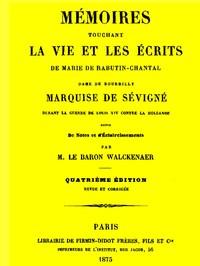
Mémoires touchant la vie et les ecrits de Marie de Rabutin-Chantal, (4/6)
Let's set the scene: 17th-century France. Salons, wigs, court intrigue. You've probably heard of Madame de Sévigné, whose letters give us a front-row seat to it all. But this book turns the spotlight away from the star and onto her mother, Marie de Rabutin-Chantal. Her story is a short, sharp tragedy. Married young, widowed young, and then killed in a bizarre and shocking accident when her famous daughter was only seven. For centuries, she was just a footnote: "the mother who died."
The Story
This isn't a novel with a plot. Think of it as a historical reconstruction. The author, Walckenaer, acts like a biographer-detective from the 1800s. He's trying to solve the mystery of a life. He scours old documents, family papers, and Sévigné's own letters for any mention of Marie. He pieces together her family background, her marriage to the Baron de Sévigné, and the few years of motherhood she had. The central, haunting event is her death—thrown from a carriage in Paris. The book asks: What was she like? What legacy did she leave in her daughter, who would grow up to write so vividly about love and loss?
Why You Should Read It
I loved this because it's about the quiet people in history. We're so used to stories about kings and generals. This is about the impact one ordinary (yet noble) woman had, simply by living and dying. It makes you think about all the mothers, sisters, and friends who shaped great artists and thinkers but never got their own biography. Walckenaer's passion is clear; he's determined to give Marie her due. Reading Sévigné's letters after this feels different. You catch the echoes of a daughter trying to understand the mother she barely knew.
Final Verdict
This is a niche but fascinating read. It's perfect for history buffs who enjoy deep dives into lesser-known figures, or for anyone who's read Sévigné's letters and wondered about her personal ghosts. It's not a light beach read—it's a slow, thoughtful piece of historical recovery. If you like the idea of literary detective work and stories that explore how family trauma echoes through generations, you'll find this surprisingly moving. Just know you're getting a specialized, academic-adjacent biography, not a dramatic novel.