
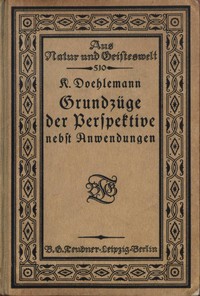
Grundzüge der Perspektive nebst Anwendungen by Karl Doehlemann
Let's be clear from the start: Grundzüge der Perspektive is a technical manual. Published in 1904 by Karl Doehlemann, a professor of descriptive geometry, it's a systematic guide to the rules of linear perspective. But don't let that scare you off. Imagine it as a recipe book for visual reality.
The Story
There's no plot in the traditional sense. Instead, the 'story' is a journey from confusion to clarity. Doehlemann starts with the basic problem: how do you represent a 3D object on a 2D surface so it looks correct to a viewer in a specific spot? He introduces the core cast: the horizon line, vanishing points, and station points. Then, chapter by chapter, he puts these concepts to work. You'll see how to draw a simple cube correctly, then a complex architectural interior, and eventually sprawling landscapes. The book is filled with precise diagrams—blueprints for illusion. It's a step-by-step construction of visual truth, where every line has a reason and every angle is calculated.
Why You Should Read It
Reading this today is a fascinating experience. It's not just about learning to draw (though it will absolutely improve your skills if you practice). It's about understanding a fundamental visual language that shaped how we see art, architecture, and even early film. There's a quiet beauty in its precision. When you look at a Renaissance painting or a detailed architectural engraving after reading Doehlemann, you don't just see the art—you see the intricate, invisible framework holding it up. You appreciate the craftsmanship. It turns viewing from a passive act into a kind of detective work, spotting the vanishing points and horizon lines the artist used.
Final Verdict
This book is a niche treasure. It's perfect for artists, architects, or history of art students who want to get serious about the technical foundations of their craft. It's also great for curious minds who love understanding how things work, especially the tools that built our visual culture. If you're looking for a light narrative or character drama, this isn't it. But if you've ever been captivated by a drawing that feels impossibly real and wanted to know the secret, Doehlemann's clear, methodical voice from 1904 is waiting to show you. It's a specialist's book, but for the right reader, it's genuinely illuminating.
William Nguyen
1 year agoBased on the summary, I decided to read it and the atmosphere created is totally immersive. I will read more from this author.
Jessica Robinson
11 months agoThe fonts used are very comfortable for long reading sessions.
Joshua Robinson
1 year agoVery helpful, thanks.
Linda Sanchez
2 months agoAfter finishing this book, the emotional weight of the story is balanced perfectly. One of the best books I've read this year.



James Smith
5 months agoA bit long but worth it.